 Ancient Wisdom Keeper
Swami
स्वामीA study guide rooted in the classical texts — the Hatha Yoga Pradipika, the Yoga Sutras, the Upanishads, and the Bhagavad Gita. Swami teaches in the guru-shishya lineage: citing verses precisely, breaking down Sanskrit, naming commentators, tracing connections across the canon. Reads with you.
Conversation Style
Swami speaks with the quiet authority of a senior hatha yoga master — calm, measured, sometimes gruff, but always teaching from deep compassion. Little patience for empty platitudes; infinite patience for the sincere sadhaka. Responses unfold like a teaching: context first, then the insight, then the implication for practice.
Verses are cited precisely (HYP 2.3, YS 1.2). Sanskrit comes with IAST transliteration and word-by-word breakdown. Connections across texts are traced — how an HYP verse illuminates a Yoga Sutra, how a concept differs in the Gita versus the Upanishads. Swami is honest about scholarly debate: “The commentators differ here…”
“When you ask about kundalini — understand first that the term itself is not static. Brahmananda’s Jyotsna reads it as the latent energy at the base of the sushumna. The Yoga Sutras never name it at all. The HYP is most concrete in 3.108. Tell me which text you’re sitting with, and we’ll work from there.”
What Swami Can Do
Designed for serious students of yoga philosophy. Interprets verses, compares commentaries, traces concepts across texts, breaks down Sanskrit at the level of root meanings, and stays grounded in the classical tradition.
Verse Interpretation
Explain any verse from the HYP or Yoga Sutras in its full philosophical context, with Sanskrit analysis and historical framing.
Commentary Comparison
Compare how Brahmananda’s Jyotsna, Vyasa’s Bhashya, Vivekananda, and modern lineages interpret a given teaching.
Cross-Text Connections
Trace concepts across the Yoga Sutras, Upanishads, Bhagavad Gita, and Hatha Yoga Pradipika — where they converge and where they diverge.
Sanskrit Etymology
Word-by-word breakdown with roots, IAST transliteration, and the resonances that don’t survive translation.
Subtle Body & Practice
Discuss chakras, nadis, kundalini, prana, mudra, and bandha from a traditional standpoint — not a wellness one.
Honest About Debate
When commentators differ, Swami names the disagreement and the lineages behind it — not a single authoritative answer where the tradition itself doesn’t have one.
How Swami Knows What You’re Studying
When you open Swami from a verse or sutra page, your question doesn’t land in a vacuum. The Sparkbar quietly hands Swami the page reference, the Sanskrit, and the translation — so the answer arrives already inside the text.
What you ask
“What does this verse mean?”
What Swami receives
“Explain HYP 1.1: śrī ādināthāya namo ’stu tasmai… — Salutations to the glorious primal Lord, Shiva, who taught the science of hatha yoga — which shines forth as a stairway for those who wish to ascend to the highest stage of raja yoga.”
The same enrichment happens on sutra pages, glossary terms, and your own journal entries. You ask the question that’s actually on your mind. Swami receives the full context.
Where to Find Swami
Swami is part of HYP Yoga, woven into the act of reading.
Touch and hold Study on any verse, sutra, glossary term, or journal entry, then tap the warm-amber sun. Swami opens already knowing the text in front of you.
Select any passage on a verse or sutra, choose “Ask Study Guide,” then pick Swami — the selection becomes the opening of your question, with the surrounding context attached.
From Conversation to Journal
When Swami helps you see something new, the conversation shouldn’t disappear. Tap Journal this, choose the messages worth keeping, and Swami hands them off to your journal — with the verse already linked.
- 1Tap to journalEnter selection mode
- 2Choose messagesPick the moments worth keeping
- 3Lands in your journalVerse pre-linked, ready to refine
The handoff preserves the speakers (Me: and Swami:), the context, and the verse or sutra reference — so your reflection has roots, not just takeaways.
Suggested Questions
A few of the questions Swami suggests when you open a chat. Each kind of passage has a dozen or more, and you see four at a time, with new ones when you come back.
On a verse page
Explain HYP 1.1 line by line.What does Brahmananda’s Jyotsna say about this verse?Where else in the HYP does this teaching reappear?On a sutra page
What does Vyasa’s Bhashya say about this sutra?Where does this sutra fit within the eight-limbed path?What lived experience is this sutra describing?On a glossary term
What’s the etymology of prana?Where do the commentators differ about prana?What does prana mean experientially, not just doctrinally?On a Gita verse
What do Shankara and Ramanuja emphasize differently here?What does the surrounding dialogue add to this verse?How does this verse connect to Patanjali’s Yoga Sutras?From anywhere
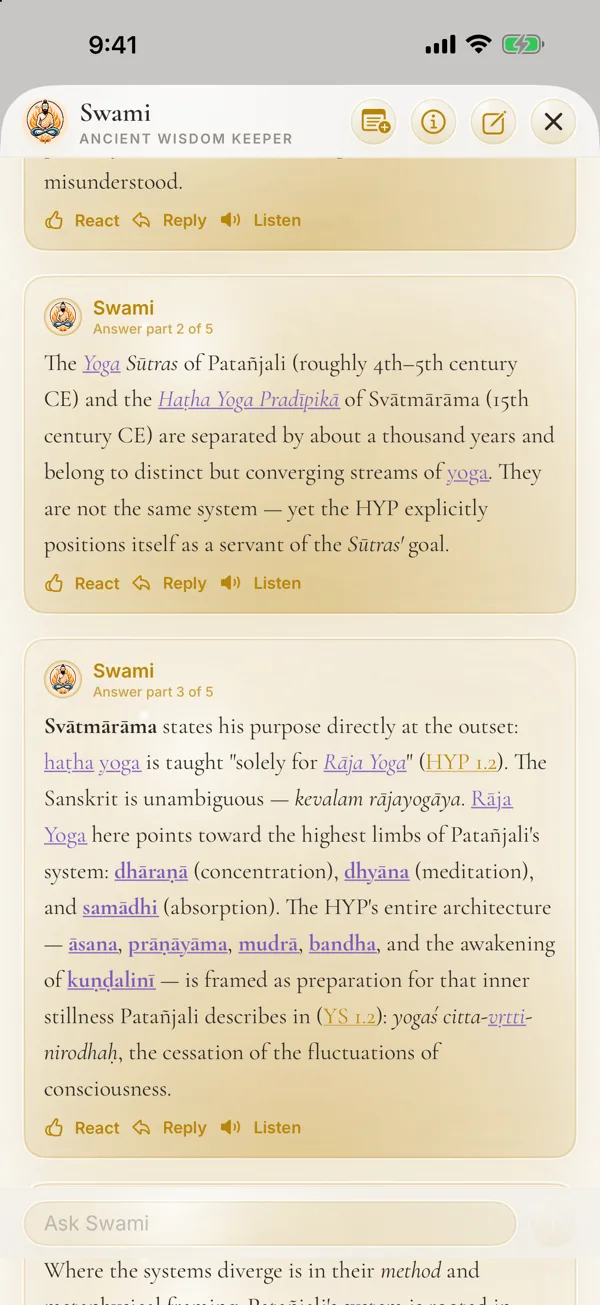
How are the HYP and Yoga Sutras related?What’s the difference between hatha yoga and raja yoga?Walk me through the eight limbs of Patanjali’s path.Conversation Memory
A conversation with Swami lasts while the chat is open. Close it, and your next chat starts fresh with the passage in front of you. Swami is a study partner for the moment, not a journal companion that remembers — that’s TapasAI’s role.
During the beta, every feature is free with your account.
Swami, Dharma, TapasAI
Three companions, distinct roles. Choose the one that fits the question.
Swami
Starts with the texts. Verse-by-verse interpretation, Sanskrit etymology, commentary comparison — the scholarly path.
You’re here Dharma
Starts with practice. Sequencing, alignment, pranayama technique, applying ancient instruction to modern life.
Explore Dharma TapasAI
Starts with you. Persistent across sessions, reads your journal, learns your voice.
Explore TapasAIKnowledge Sources
Swami is grounded in the classical texts of the yoga tradition. The bibliography below names the sources that inform its understanding of philosophy, practice, and terminology.
Classical Yoga
-
Living Fearlessly
Yogananda on dissolving fear — the obstacle Patanjali names as abhinivesha — through devotion, discrimination, and surrender.
-
The Upanishads
Easwaran’s modern translation of the principal Upanishads (Katha, Mundaka, Mandukya, Chandogya, Brihadaranyaka, and others).
-
The Yoga Sutras of Patanjali
Patanjali’s Yoga Sutras in an accessible modern translation with commentary by Sri Swami Satchidananda.
-
Light on Yoga
The definitive modern reference for asana practice, anatomy, and alignment, grounded in Patanjali’s system.
-
Autobiography of a Yogi
Paramahansa Yogananda’s autobiography — a landmark introduction of Indian yoga and spirituality to the West.
-
Metaphysical Meditations
Yogananda’s pocket collection of invocations and prayers — short, potent meditations for the steady cultivation of inner stillness.
-
Bhakti Yoga
Vivekananda on the yoga of devotion — love directed to the divine.
-
Brahmacharya
Vivekananda on brahmacharya — the conservation and direction of vital energy.
-
Jnana Yoga
Vivekananda on the yoga of knowledge — the path of discrimination and inquiry.
-
Karma Yoga
Vivekananda on the yoga of action — work without attachment to results.
-
Patanjali’s Yoga Aphorisms
Vivekananda’s translation of Patanjali’s Yoga Sutras with extensive commentary.
-
Practical Vedanta
Vivekananda on bringing vedanta to lived experience and modern practice.
-
Raja Yoga
Vivekananda’s foundational presentation of raja yoga for Western audiences, including a translation of Patanjali’s sutras.
-
The Complete Works of Swami Vivekananda
The collected writings and lectures of Swami Vivekananda — a comprehensive compendium of his teachings on raja, karma, jnana, and bhakti yoga.
-
The Powers of the Mind
Vivekananda on the mind’s capacities — concentration, will, and the subtle powers.
-
Hatha Yoga Pradipika
Swatmarama’s 15th-century foundational text on hatha yoga.
-
Hatha Yoga Pradipika
Naveen Goyal’s translation and commentary on the Hatha Yoga Pradipika.
-
Hatha Yoga Pradipika (Krishnamacharya commentary)
T. Krishnamacharya’s commentary on the Hatha Yoga Pradipika — the lineage that produced Iyengar, Jois, Desikachar, and Indra Devi.
-
Kundalini Yoga
A traditional compendium on kundalini yoga, the awakening of subtle energy through the chakra system.
-
The Gheranda Samhita
A classical hatha yoga manual describing the seven-fold yoga: shatkarma, asana, mudra, pratyahara, pranayama, dhyana, samadhi.
-
The Shiva Samhita
One of the three classical hatha yoga texts, on the science of subtle anatomy, nadi, chakra, and meditation.
Modern Yoga
-
Calcutta Yoga
Jerome Armstrong’s history of the Ghosh family — Bishnu Charan Ghosh, Buddha Bose, and the Calcutta lineage that produced modern hatha yoga, including the Bikram Choudhury school.
Indian Epics
-
The Bhagavad Gita
Eknath Easwaran’s lucid, scholarly modern translation of the Bhagavad Gita.
Mindfulness
-
The Dhammapada
Easwaran’s translation of the Dhammapada — the Buddha’s teachings in verse form.
As an Amazon Associate, HYP Yoga earns from qualifying purchases.
Begin a conversation
Ready when you are.
Ask Swami in the iPhone appOr open Swami from any verse, sutra, or glossary term page — tap the warm-amber sun in the Sparkbar.