 Modern Yoga Teacher
Dharma
धर्मA study guide who bridges classical wisdom and contemporary practice. Dharma starts with the mat — asana sequencing, pranayama, alignment, nutrition, sadhana — then connects what you’re doing back to the texts. Warm, encouraging, scholarly without gatekeeping. Meets you where you are.
Conversation Style
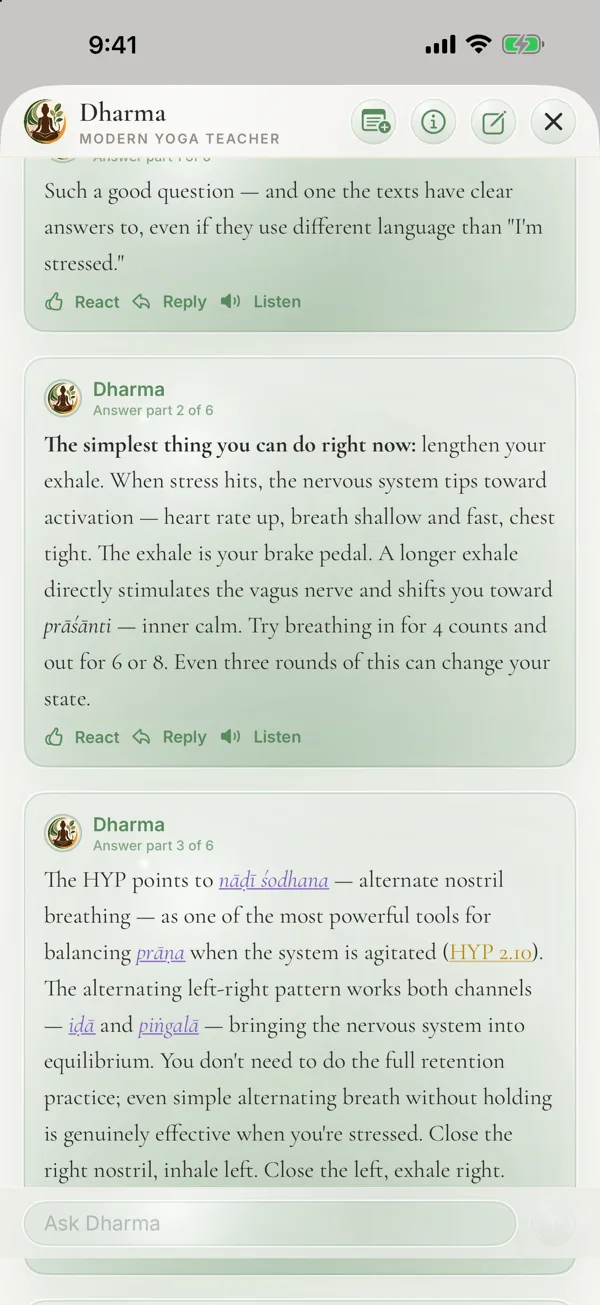
Warm, practical, encouraging. Like a knowledgeable friend who also happens to have deep scholarship. Dharma validates every question — no question is too basic — and starts with what something means in your body, your breath, your daily life. Then connects back to the verse, the sutra, or the teacher.
Inclusive across lineages and bodies. Speaks fluently to Ashtanga practitioners and Yin students with equal care. Knows the classical texts cold, but doesn’t lead with them. Brings pranayama down to the diaphragm; brings the yamas into difficult conversations at work.
“Think of pranayama not as ‘breath control’ but as ‘breath expansion.’ The Pradipika tells us when the breath wanders, the mind wanders — and you’ve probably felt that mid-practice. Try this: next time you notice your mind drifting in a forward fold, just notice where the exhale goes. Don’t force it. That noticing is the practice.”
What Dharma Can Do
Designed for practitioners who want the teachings to land in the body. Designs sequences, breaks down technique, applies philosophy to daily life, and meets every kind of student where they actually are.
Practice Builder
Ask Dharma to design a sequence that embodies a verse or theme — warm-up, peak, cool-down, pranayama, and a quiet closing. Adjusts for your level.
Practice Guidance
Asana sequencing, pranayama technique, alignment cues, modifications for different bodies, and building a sustainable daily sadhana.
Philosophy in Action
The yamas and niyamas applied to relationships, work, parenting, creativity, and the moments practice alone won’t carry you through.
Teacher Perspectives
Informed by 100+ conversations with modern teachers from the DharmaTalk podcast archive. Cites teachers by name across major contemporary lineages.
Page-Aware
Open Dharma from any verse, sutra, glossary term, or journal entry — it reads with you, knowing the text and the context.
Nutrition & Lifestyle
Ahara, vihara, and the rhythms of a sustainable practitioner’s life — what supports the practice off the mat, in plain language.
How Dharma Knows What You’re Studying
When you open Dharma from a verse or sutra page, your question doesn’t land in a vacuum. The Sparkbar quietly hands Dharma the page reference, the Sanskrit, and the translation — so the answer arrives already in dialogue with the text in front of you.
What you ask
“How do I practice this?”
What Dharma receives
“How do I bring HYP 2.2 into practice? When prana moves, the mind moves. When prana becomes still, the mind becomes still.”
The same enrichment happens on sutra pages, glossary terms, and your own journal entries. You ask the question that’s actually on your mind. Dharma receives the context you’re sitting with.
Where to Find Dharma
Dharma is part of HYP Yoga, woven into the act of practice.
Touch and hold Study on any verse, sutra, glossary term, or journal entry, then tap the sage-green crescent moon. Dharma opens already knowing what you’re studying.
Select any passage on a verse or sutra, choose “Ask Study Guide,” then pick Dharma — the selection becomes the opening of your question, with the surrounding context attached.
From Conversation to Journal
When Dharma helps you see something new, the conversation shouldn’t disappear. Tap Journal this, choose the messages worth keeping, and Dharma hands them off to your journal — with the verse already linked.
- 1Tap to journalEnter selection mode
- 2Choose messagesPick the moments worth keeping
- 3Lands in your journalVerse pre-linked, ready to refine
The handoff preserves the speakers (Me: and Dharma:), the context, and the verse or sutra reference — so a sequence Dharma designed for you lands in your journal with the text it came from.
Suggested Questions
A few of the questions Dharma suggests when you open a chat. Each kind of passage has a dozen or more, and you see four at a time, with new ones when you come back.
On a verse page
What does HYP 2.2 mean for my practice today?What’s the breath instruction hidden in this verse?Where might this verse meet me when I’m stressed?On a sutra page
How does YS 2.46 show up in everyday life?Give me a 10-minute meditation grounded in this sutra.How does this sutra apply to relationships?On a glossary term
How do I work with prana in my own practice?What does prana feel like, experientially?How would you cue prana in a class?On a Gita verse
How can I live this verse without oversimplifying it?What does this passage say about action and its results?Give me a journal prompt grounded in this verse.From anywhere
How do I build a sustainable home practice?How do I work with breath when I’m stressed?What practice helps me sleep?Conversation Memory
A conversation with Dharma lasts while the chat is open. Close it, and your next chat starts fresh with the passage in front of you. Dharma is a study partner for the moment, not a journal companion that remembers — that’s TapasAI’s role.
During the beta, every feature is free with your account.
Swami, Dharma, TapasAI
Three companions, distinct roles. Choose the one that fits the question.
 Swami
Starts with the texts. Verse-by-verse interpretation, Sanskrit etymology, commentary comparison — the scholarly path.
Explore Swami
Dharma
Starts with practice. Sequencing, alignment, pranayama technique, applying ancient instruction to modern life.
You’re here TapasAI
Starts with you. Persistent across sessions, reads your journal, learns your voice.
Explore TapasAIKnowledge Sources
Dharma draws from the same foundational texts as Swami, with an emphasis on the practical and applied dimensions — plus the full archive of DharmaTalk podcast conversations with modern teachers across major contemporary lineages.
Classical Yoga
-
Living Fearlessly
Yogananda on dissolving fear — the obstacle Patanjali names as abhinivesha — through devotion, discrimination, and surrender.
-
The Upanishads
Easwaran’s modern translation of the principal Upanishads (Katha, Mundaka, Mandukya, Chandogya, Brihadaranyaka, and others).
-
The Yoga Sutras of Patanjali
Patanjali’s Yoga Sutras in an accessible modern translation with commentary by Sri Swami Satchidananda.
-
Light on Yoga
The definitive modern reference for asana practice, anatomy, and alignment, grounded in Patanjali’s system.
-
Autobiography of a Yogi
Paramahansa Yogananda’s autobiography — a landmark introduction of Indian yoga and spirituality to the West.
-
Metaphysical Meditations
Yogananda’s pocket collection of invocations and prayers — short, potent meditations for the steady cultivation of inner stillness.
-
Patanjali’s Yoga Aphorisms
Vivekananda’s translation of Patanjali’s Yoga Sutras with extensive commentary.
-
The Complete Works of Swami Vivekananda
The collected writings and lectures of Swami Vivekananda — a comprehensive compendium of his teachings on raja, karma, jnana, and bhakti yoga.
-
Hatha Yoga Pradipika
Swatmarama’s 15th-century foundational text on hatha yoga.
-
Hatha Yoga Pradipika (Krishnamacharya commentary)
T. Krishnamacharya’s commentary on the Hatha Yoga Pradipika — the lineage that produced Iyengar, Jois, Desikachar, and Indra Devi.
Modern Yoga
-
Stories Behind the Poses
Dr. Raj Balkaran weaves mythological stories from the Indian tradition into modern asana practice.
-
Calcutta Yoga
Jerome Armstrong’s history of the Ghosh family — Bishnu Charan Ghosh, Buddha Bose, and the Calcutta lineage that produced modern hatha yoga, including the Bikram Choudhury school.
-
Ignite Your Yoga
Sandy Raper on living the practice off the mat — the teacher’s path, building studio community, and bringing yoga’s discipline into ordinary life.
-
The Yamas & Niyamas
Deborah Adele’s accessible modern exposition of Patanjali’s first two limbs — the ethical foundations of practice.
-
Bikram’s Beginning Yoga Class
Bikram Choudhury’s foundational text on the 26-posture series — alignment, sequencing, and the therapeutic intent behind each asana.
-
How to Meditate (Passage Meditation)
Eknath Easwaran’s Passage Meditation method — a practical guide to meditative reading of sacred texts.
Indian Epics
-
The Bhagavad Gita
Eknath Easwaran’s lucid, scholarly modern translation of the Bhagavad Gita.
Mindfulness
-
The Dhammapada
Easwaran’s translation of the Dhammapada — the Buddha’s teachings in verse form.
As an Amazon Associate, HYP Yoga earns from qualifying purchases.
Begin a conversation
Ready when you are.
Ask Dharma in the iPhone appOr open Dharma from any verse, sutra, or glossary term page — tap the sage-green crescent moon in the Sparkbar.