What I hold to
A few commitments shape every decision I make about HYP Yoga. When a feature or an idea would bend one of them, the feature gives way.
- i.
The texts are always free
The Hatha Yoga Pradipika, Patanjali’s Yoga Sutras, and the Bhagavad Gita can be read in full, with no account and no paywall. Classical texts are not a product. They belong to everyone who wants to study them.
- ii.
No ads. Ever.
HYP Yoga will never show advertisements or sponsored content. It is a place to study, not a place to be sold to.
- iii.
Technology serves the practice
Every tool has to answer one question: does this help someone study the texts more deeply? If it doesn’t, it doesn’t belong, however clever it is.
- iv.
Respect, without pressure
No streaks, no urgency, no guilt, no “you’re missing out.” You should feel respected whether you read for five minutes or write every day, and whether or not you ever sign in.
- v.
Reverence in everything
These are authoritative classical texts from a living tradition. I try to honor them through care and precision: Sanskrit with its diacritics, verses and sutras cited by number, and a reading experience that feels like opening a beautiful book.
- vi.
Independently stewarded
HYP Yoga answers to practitioners, not to investors or engagement metrics. I make its decisions myself, and I make them with the people who study here in mind.
The path
I think of study as a climb, and of HYP Yoga as what you carry with you.
- The guides
Swami, the sun · Dharma, the moon
On this path, you are never alone. From the start, you are given two guides: Swami, the sun, and Dharma, the moon. Along the way you also come to carry TapasAI — not a persona like the guides, but a reflection of your own best self.
- The maps
The texts, read again and again
For the hatha yogi, the path leads to the summit: Raja Yoga. The guides act as sherpas. The Hatha Yoga Pradipika, the Yoga Sutras, and the Gita — with more classical texts to come — are the maps, read and consulted again and again on the way up.
- The gateway
Hatha Yoga
Hatha Yoga is the gateway. It stands at the end of the path upward, and through it the yogi passes into the summit, which is Raja Yoga.
- The steps
Reading · Reflecting · Illuminating
Each step of your own deepening — reading, reflecting, illuminating — brings you one level higher. It is not a hierarchy of better and worse, only a sequence, each step a little closer to the summit.
- The compass
TapasAI
TapasAI is your compass. It helps keep you on course without choosing the direction for you, and it knows the landmarks well enough to help you read the signs along the way. Neither the maps nor the compass is enough on its own for most of us. The sherpas have made the journey many times, but they cannot walk it for you — and some practitioners may not need a sherpa at all.
Study. Reflect. Illuminate.
The app is built around three ways of being with the texts. They aren’t levels to pass through; they are modes you move between as your practice asks.
Study
Read Sanskrit, transliteration, and English together. QuickTerms and the Glossary open unfamiliar words, and Swami and Dharma are there when a question opens up. The reading page stays quiet on purpose, like print.
Reflect
The journal is the heart of HYP Yoga. Write about a verse that challenged you, record a Voice Spark, or log the asanas you practiced with the Asana Log. Smart Journal offers a place to begin, and TapasAI helps you follow the threads of what you write. Keep a reflection for yourself, or share it with Sangha — practitioners gathered around the study of the texts, with no likes to count and no feed to chase.
Illuminate
Sparkmarks and Sparklights let you mark what resonates. AI Sparks bring out connections across texts and traditions. Each Spark is a way of saying “this matters,” and the app’s job is to remember.


AI that guides, never ghostwrites
Swami, Dharma, and TapasAI are study companions. They help you think; they don’t think for you, and they don’t write your reflections.
When a companion cites a verse or sutra, you can tap the citation and read the passage for yourself, so you can follow the thread. TapasAI also draws on the HYP Yoga Library, a curated collection of real passages from the classical and contemplative traditions.
Before your words reach an outside AI service, you’re told which services receive them and why. You should always know where the AI’s words came from, and where yours go.
Built for the edges
If someone can’t study the texts because of how their body works, I count that as a design failure, not a small market to set aside. So I try to design for the practitioner with the most constraints, and I find the experience improves for everyone.
Readable typefaces such as Atkinson Hyperlegible and Lexend help people with visual or reading differences — and anyone reading in bright sunlight. Voice Sparks let someone who can’t type still keep a journal, and let anyone reflect while walking.
Who is this leaving out, and how could they be included?
Who is this leaving out, and how could they be included?
The questions I keep asking are simple: who is this leaving out, and how could they be included?
Where it’s going
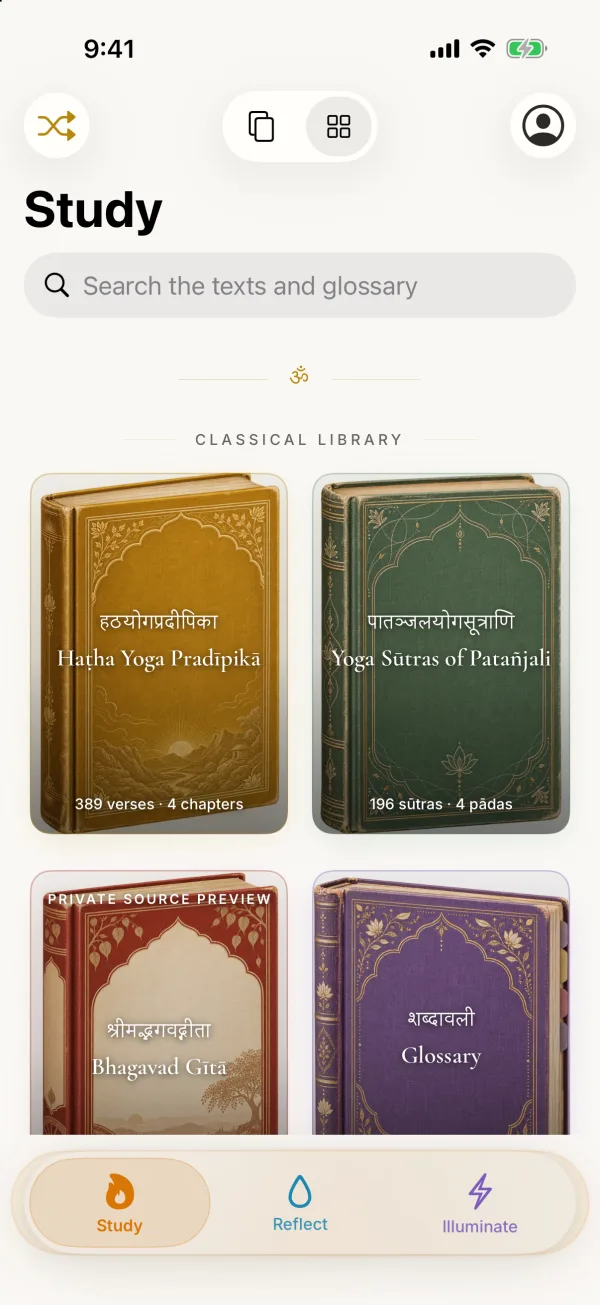
Right now, HYP Yoga is an iPhone app in a TestFlight beta, and during the beta every feature is free with an account. Your experience in the beta is shaping what comes next.
Beyond the beta, I hope to bring in more of the classical texts, to keep deepening accessibility — including new ways to read and reflect for people who can’t use a keyboard or a touchscreen easily — and to bring HYP Yoga to more devices.
Whatever changes, the commitments on this page don’t.
Begin the path
Request the HYP Yoga iPhone beta and help shape a thoughtful home for study and reflection.
Request the iPhone beta